|
Home >>
Painting Basics >> Color
<< Interior Decorating
>>>
The Theory of
Color.
Classification
of Colors.
Color
Terminology.
Methods of Combining
Colors.
Color Values.
Color Harmonies.
Color and
Illumination.
Color
Symbolism.
Heraldic
Personal Choice of
Colors.
Le Courrier Legibility
list.
Color is defined as visual sensations produced upon the retina by lightwaves
of varying length, and the first thing to remember about it is that it has
no tangible form. It is an impression produced by the ability of a surface
to reflect certain parts of white light and to absorb others. The impression
depends upon the presence of light; where there is no light, there is no
color.
Sir Isaac Newton was the first to show, in 1666, that a ray of light passed
through a prism of glass is broken up into a series of bands of the different
colors which are the constituent parts of the ray. The image presented by
thisprocess is known as the spectrum.
The colors of the spectrum are: red, orange, yellow,green, blue and violet;
the limits of each are not sharply defined but merge into each other, and
between them are an indefinite number of intermediate colors.
The space occupied by blue and violet is rather bigger than that taken up
by any other adjacent pair, so it is customary to include another color -
purple; thses six (or seven) colors are known as the colours of the
rainbow for they can be seen, in varying intensity, when there is a rainbow
in the sky.
It is necessary to distinguish between the color which depends on light alone
(e.g. when a ray of light is passed through a prism) and that which results
when a ray of light is partially absorbed and reflected by a substance such
as a pigment; it is the latter form of colour which the painter and decorator
is chiefly concerned.
There are numerous sets of rules formulated with the idea of assisting the
beginner to devise color harmonies based on scientific lines. The value of
these systems must be regarded as limited; it is true that they will indicate
certain colors which harmonise with each other but they can give no idea
of the proportion in which esch color may be used. In practice, the successful
grouping and management of colours is largely a matter of proportions.
In fact,a skilful and experienced designer will sometimes combine two or
more colors which, according to the rules, ought never to be combined and
still obtain a perfectly satisfying result.
There are broad principles on which colors are classified.

Speaking in terms of pigmentary color( which, for this purpose, includes
not only paints but also stains and dyestuffs), there are three PRIMARY colors,
so called because they cannot be obtained by combining any other hues.
These are: red, yellow and blue.
There are also three secondary colors.
These are: orange, purple and green, obtained by mixing equal parts of two
of the primaries.
Red and Yellow make Orange.
Red and Blue make
purple.
Yellow and Blue make Green.
By mixing together two secondaries, we get a third group, known as
Tertiaries.
These are: russet, citron and olive, obtained by mixing two parts of one
primary with one part each of the other two primaries.
Orange and Purple make Russet.
Orange and Green make Citron.
Purple and Green make Olive.
There is sometimes confusion between prismatic "color-light" (i.e.
non-pigmentary) and pigmentary color. In theory the three primaries, if
compounded in the exact proportions, should produce a white but in fact produce
a grey. In practice, because of the complex nature of pigments, it is impossible
to reproduce the range attainable by the purity of colored-light.
On the computer we can produce a wide range using the RGB (red, green, blue)
system. The green incorporating the other primary; yellow. The range is often
stated as 16.7 million colors. This is arrived at by combining 256(red) x
256(green) x 256(blue), which gives 16,777,216 combinations. In fact computers
count from 0 to 255; 0,0,0 equalling black and 255,255,255 equalling white.
If you use the same number between 0 and 255 for red, green
and blue you will only get a graduation between black and white, mostly greys;
the very lower numbers appear as black and the very higher numbers as white.
Complementary colors are the color which contrast most with each other. A
note of contrast is often of value in adding strength to a decor which may
otherwise seem dull. On color wheels the complementaries are always opposite
each other on the wheel.
The most important terms used in connection with color are the following:
Hue.- The predominant impression given by any particular color,
irrespective of its tint or shade. Hue may be regarded as being synonymous
with colour.
Tint. - Modifying the color by adding white.
Shade. - Modifying a color by adding black to it.
Tone. - The degree of lightness or darkness of a color , in comparison
to black or white. Usually referred to as Lightness in computer paint
applications.
Purity. - The relative purity of a color depends to the extent to
which it has been contaminated or greyed by the admixture of another color.
Usually referred to as Saturation in computer paint applications.
Color schemes are broadly classified under various headings, of which the
most important are:
Mono-chromatic. - By this is meant treatment based on the use of a
single hue, variations being obtained by the additions of white or black
to the color. There is no reason why such a scheme should be in the least
dull since the range of effects possible is very wide. For example, the same
color used on two differently textured surfaces will show a subtle variation,
due to the fact that the reaction to light is dissimilar.
Analogous coloring. - This implies harmony which is the result of
combining colors which have a close affinity to each other. Use the color
wheel to employ colors which are adjacent to each other; the number of colors
used like this should be four at
the
most.
Contrasting coloring. - You can produce an effective scheme by introducing
a note of contrast. This can be done by using a complementary or contrasting
color. Making a color wheel of your own (with 12 colors like the one at top
of this page) is more helpful than studying a book or browser as the colors
are not always faithfully reproduced. Conrasting color are opposite each
other on the wheel.
Relative value of colors. certain colors are described as
advancing because they give prominance to surfaces and make them stand
out. REDS, YELLOWS and ORANGE possess this property and to a lesser degree
do the darker shades of most colors. Advancing colors must be used
with discretion in a small room or they can make it even smaller looking
than it really is.
Other colours have the contrary effect and are known as receding colours;
these include the lighter tints, especially blues and greens.
Color harmony is mainly a matter of proportion and a combination of colors
which appears discordant can often seem pleasing if the proportions of one
or more of them are carefully adjusted.
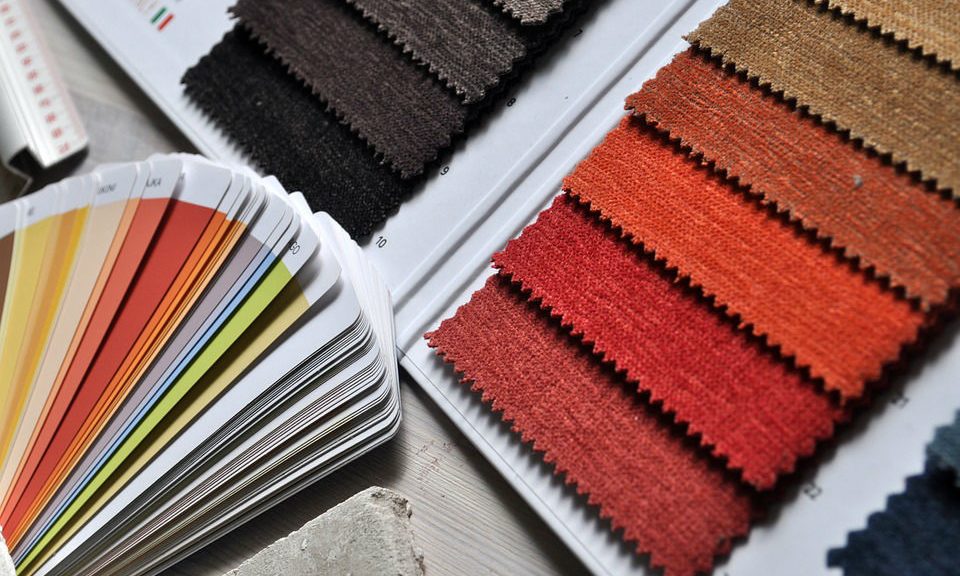
Because of the absence of a generally accepted system of color nomenclature,
to refer to individual colors by name is an unsatisfactory form of
identification. Often a color of the same name by different manufacturers
will not produce a match.
There is an official standard for colours for various purposes, e.g.
building, the BS number or British Standard.(Other countries have
similar, e.g. Australian Standard.) The main relevance of these BS
numbers is in building and contract Specifications; usually the name of the
paint manufacturer is stipulated as well.
The Audsley List of Color Harmonies. The following is abridged from
the Audsley list and is shown as a basis for practical experiment and not
as color dogma.
Blue harmonises with orange; with gold or bright yellow; with maize;
straw colour; salmon; crimson; pink; lilac(pale); drab; stone colour; fawn(pale);
grey(weak and cold); chestnut; chocolate; brown; bright white; black; orange
and black; scarlet and purple or lilac; orange and green; brown, crimson
and yellow or gold; orange, black and white.
Red harmonises with green( a pink and an apple green is one of the
brightest); gold or yellow( strong and bright); blue; grey; white(very bright);
yellow and black; yellow or gold, black and white.
Scarlet harmonises with blue-green; blue; purple or (dull)lilac; violet(
sombre); slate; blue and grey-blue; blue and white; black and white; black
and yellow or gold.
Crimson harmonises with yellow-green; yellow or gold; orange; maize;
purple; drab; brown; black.
Yellow harmonises withpurple; blue; violet; deep crimson; lilac; chestnut
or chocolate; brown; black; white; purple, scarlet and blue.
Green harmonises withred; scarlet; russet; if containing blue, tinge
with orange; if deep, with a strong yellow or gold; black; white; scarlet
and blue; crimson, blue and bright yellow or gold.
Orange harmonises withblue; olive; violet; chestnut; deep brown; crimson
and green; crimson and blue; purple and scarlet; blue, scarlet and green;
violet, scarlet, white and green.
Purple harmonises withyellow; citrine; bright yellow or gold; maize;
matt black; white; scarlet and yellow or gold; scarlet and white; scarlet,
blue and orange; scarlet, blue, yellow and black.
Lilac harmonises with bright yellow or gold; primrose; maize;
cerise;crimson; grey; white;black; crimson and yellow or gold.
Violet harmonises with yellow or gold; orange; maize.
White harmonises with most colours and colour mixtures.
Black harmonises with white; bright yellow; orange; maize; primrose;
salmon; pink; scarlet; cerise; yellow-green; drab; fawn; buff; slate; grey;
olive; citrine; scarlet and blue-green; crimson and lemon-yellow; crimson
and yellow-green.
A common illusion that the use of a high-gloss paint or other glossy finish
will make the room lighter than a matt finish of the same hue. In fact each
will reflect the same amount of light with this difference;
When light strikes a surface, it is thrown back at various angles depending
on the texture of the surface.
Color(colour) Symbolism.
For those called upon to undertake church decoration, there is a symbolic
significance of colors used in ecclesiastical
work.
White: light and purity
Blue: contemplative faith
Red: militant faith; fire; charity
Green: hope
Black: mourning
Various saints also have a traditional association with certain colors.
St.Matthew: green; St.Mark: purple; St.Luke: blue; St.John: red; St.Peter:
blue;St.George: red and white; St.Paul: purple and white; St.Thomas: grey;
St.Andrew: red; St.Mary: blue; St.Patrick: green and gold.
Heraldry.
The colors in heraldry, known as tinctures, should be as bright and
as pure as possible. White may used for silver and yellow for
gold.
gules red; azure blue; vert green; purpure purple;
sable black; argent silver; or gold.
Personal Choice of Colors(colours).
Choosing the right paint color is a dilemma we have or will face at some
time in our lives. Due to the different elements in everyone's home, there
is no exact science that will apply to all. The amount of natural light,
artificial light, flooring colors, furniture colors and personal taste will
all effect the outcome of the painted surfaces. Use your key item as a starting
point for paint colors. Pick the paint samples that most closely match or
blend with your key items. Buy the smallest quantity you can, and test it
in the room to be painted.
Here is the best way to test paint colors. Start with white walls because
any other contrast will give you a false impression of the color you are
testing. If the walls are not white, apply a coat of primer, which is naturally
white and can be used later. Roll one large swatch about four feet square
onto the darkest wall, typically the window wall, and another on the sunniest,
typically the one opposite the windows. Live with it a few days. If you are
not pleased and drawn to the color, try something different.
Deciding on the woodwork color for your home interior can also be confusing
but is really easy. Remember that white goes with virtually anything. Keep
it simple and the same throughout your home. Let's assume you have
different
colors on the walls throughout your home, whether they are subtle in difference
or dramatic. A very unifying way to treat your woodwork and ceiling is to
paint them all the same color. For example: Your master bedroom may be painted
a pale blue, your daughter's room lavender, the study has a textured neutral
wallpaper, the main living areas are painted warm beige, and the kitchen
has a patterned wallpaper in blues, lavenders, and whites. You would now
paint all of the woodwork in your home, white or a custom blend of very soft
beige. Though the effect is subtle, it keeps all of the rooms related to
each other. Let's assume you are painting your walls a neutral or light color,
such as taupe, beige, cream, ivory, or pale yellow. For your moldings and
doors, etc. have the paint store mix a blend of your color choice cut with
white. A common formula for this is one part color to three parts white.
Remember to always test a sample before total application. This same blend
of color and white will be perfect for your ceiling, too.
Don't worry about white ceilings, as decorators we realize that most new
home construction gives you a basic white ceiling throughout your home. If
it is cost prohibitive to do anything else, then the pure white ceilings
are fine. It is much more important to address other decorative necessities.
Please do not loose any sleep over having pure white ceilings. If your ceilings
are pure white, then consider painting all your woodwork pure white as well.
Sometimes this is more desirable. Personal preference plays the larger role
in this decision, rather than a decorating right or wrong. Although, if budget
and personal preference leads you to using a color on the ceiling, use the
above formula as a general rule. Using dark or contrast colors can be a wonderful
look, but must be carefully considered and tested. A dark ceiling will make
the ceiling seem lower.
One idea that can be a compromise and stunning is painting the ceiling a
very soft blue or lavender, evoking the sky. In many of the new homes across
the country, tray ceilings are very popular. This style ceiling provides
wonderful opportunities to paint part of the ceiling in an accent color that
coordinates with your scheme without overwhelming the whole room. This does
not mean you would use this color on your door and floor skirting boards.
The ceiling treatment is for accent only. I cannot stress enough how strongly
I recommend testing paint colors. It can be the difference in disappointment
and happiness with your design project.
|
|