Painting and Decorating on the Net

Home > Interior Decorating > Faux > Marbling <<< Simple Carrara Marble >>>


Imitation marble.

Marble has a very wide range of colors and patterns. Or mostly lack of patterns. Transparent oil-glaze is the most common medium used for marbling nowadays. You can make your own but it is much more convenient to buy ready-made glaze. For most marbles, the best surface to work on is one which has a good coat of white eggshell paint. Or even two coats. Make sure you are working in an area which is as dust-free as possible.
Carrara.

  • With a soft clean cloth rub some transparent oil-glaze over your prepared surface.
  • Using black colored glaze and a small artists brush make some squiggly lines and a few odd spots and splashes.Bozzle.com image:carrara marble
  • With a dust brush or dry 3" paint brush soften out all the markings you have made using light soft strokes.
  • Clean out your artists brush and dip it in turpentine and make wet lines over the surface generally following the direction of your original black lines.
  • Again apply the dust brush softening the wet lines by brushing across them horizontally.
  • Finally, with the softest brush you have got(preferably a lily or badger) gently stroke the surface in all directions to remove any brush lines or marks.
  • The picture on the right is only to give you a feel for the marble and is not for you to try and imitate.

have some knowledge of the art and the following brief notes will serve as an introduction.

Since nearly everyone who executes marbling work is also a grainer, the two arts are often associated and they have a certain amount in common. Success in both depends upon long and Continuous study of the natural material and, in the case of marble, this is often difficult, since good specimens are not easily come by. Yet only by close and prolonged examination can the student gain the knowledge of markings and formations which is essential if he is to reproduce marbles in paint with any degree of skill and assurance.

The colors used in marbling are richer and more variegated than those employed in graining, and the effects are obtained largely by means of glazes rather than by the use of opaque colors. The whole process is more flexible than graining, for the markings are far more irregular than those of wood, and, moreover, the same piece of marble may exhibit wide variations both in colouring and veining on different parts of its surface.

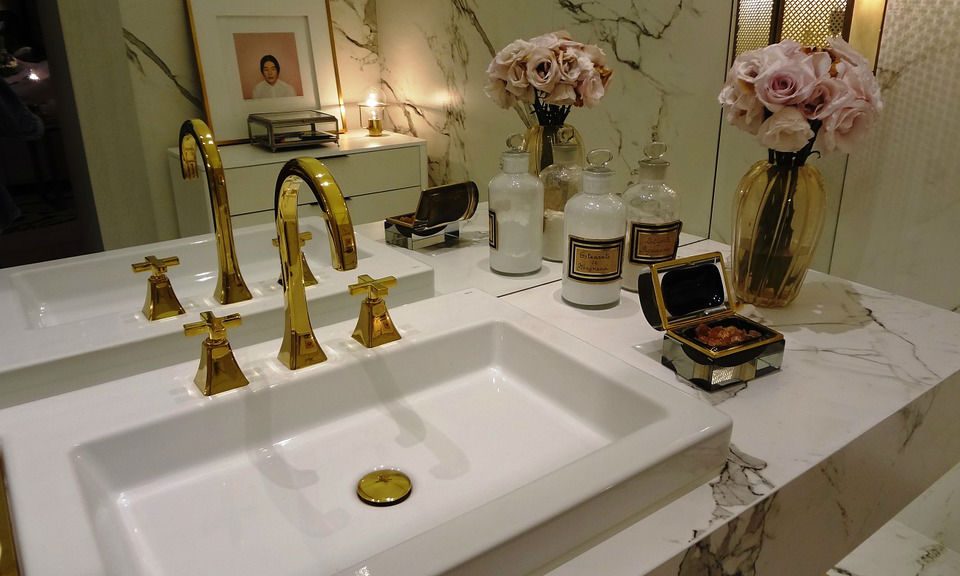
As for graining, only the highest-grade colors should be used and tube colours are strongly recommended. The tools employed consist mainly of brushes and should include sable and ox-hair pencils, fitches, hog-hair and badger softeners, and Bozzle.com image:bathroom with faux marble goose-feathers, in addition to rags, sponges, palette, and dippers for oil and turpentine.

Crayons of various colours will also be wanted.
Colors for Marbling. In graining there is considerable difference of opinion as to the best colors for grounds and graining coats, many experts having their own ideas on the subject. There is an even wider divergency of views in marbling, and it is hardly an exaggeration to say that very few marblers are in complete agreement on what should be used, even for the ground coats. With this reservation, the following notes will be found helpful:
Alabaster. The ground in this case will be white or light cream, and the beautiful stone can only be successfully imitated if it is remembered that it is quite necessary to produce a translucent effect. There are many different varieties of this stone, and the colors used must differ according to the judgment of the marbler. Rich brown, brownish red, and yellow are the best colors to use with occasionally the introduction of a little blue.

Black and Gold.-The ground should be dull black (ivory black in preference) and the veins put in not with gold leaf or bronze, as is so often done, but with a color which approximates that of gold, such as an admixture of yellow ochre, orange chrome, and white lead or zinc oxide tinted with a little Indian red and a touch of black. The form of the streaks of gold must be carefully studied. They are irregular and are most conveniently put in by means of a swan’s feather, which is dipped in the color and twisted from side to side.

Brocatelle Marble .The ground color is white to which has been added a very little blue. Cobalt or ultramarine will, in general, give better results than Prussian blue. This work is most successful when done in oil, and a little violet introduced into the markings will be found to be of service.

Derbyshire Spar.-This stone-which it may be mentioned consists principally of sulphate of barium of the familiar “barytes” used for the “extension” of white lead and paint and also for many other purposes is semi-opaque and is tinged with brown marks due to the presence of oxide of iron. The stone is but rarely imitated, but a close study of it will show that it is capable of producing very good effects when light colours are required. The process is very similar to that employed in imitating onyx excepting that the lines or markings are fewer and better defined The marks may be made with Vandyke brown, black, and Indian red, the last being only used at intervals in order to emphasise the effect and relieve the monotony. The colour used should be transparent, so that the white or rather grey ground may show through.

Dove Marble. The ground should be a light lead or grey color made from white lead, raw or boiled linseed oil, turpentine, and patent driers, tinted with approximately equal parts of blue and drop black, with a little Indian red added. The veins should be put in with a feather in bluish black and they should be irregular and quite thin. Careful blending is necessary to ensure success in this class of work.

Egyptian Green or Vert de Mer Marble.-The ground is black, in oil paint with a little varnish in it, which must be well prepared and laid perfectly smooth on the surface of wood or slab to be marbled. This stone is a variety of serpentine and the prevailing color is green, made by the addition of Brunswick green and a little white lead. Some marblers like the addition of a very little brighter green in parts. The markings should be more or less transparent and the work be done with a feather aided by a suitable crayon.

Granite (Red) Imitation. 2 lb. of white lead to which is added 2 oz. of Venetian red in oil, and 2 oz. of vermilionette (light shade) will produce a very good ground for this work. It should be thinned with about equal parts of turpentine and linseed oil, with the addition of driers. Grey granite requires for a ground only a light-grey colour made by mixing white lead with a little black.
The imitation of granite, whether grey or red, is comparatively easy. In the stone itself there are three constituents which are to be reproduced, viz; quartz which is nearly white and translucid, feldspar which is similar to the quartz but is opaque, and mica. The mica occurs in very small shining specks. All of these may be reproduced with fidelity, provided that care is taken to obtain the transparent appearance of the quartz and the correct colouring of the other parts.
As a rule the “dots” which make up the greater part of the work are best put in by means of a small piece of sponge, but care must be taken to select a piece which is not too coarse or irregular. Perfect uniformity is not aimed at, as it would not be natural. A graniting brush which has been specially prepared for this work is preferred by many to a sponge. Parts of the brush are cut away so that when it is “dabbed” against the work a series of irregularly shaped and spaced dots or specks will be given. A stippler very carefully prepared and cut for the purpose would, although costly, make a tool which would be productive of excellent work and- because of its broad surface-be capable of doing such work very economically.

Italian Pink Marble.-The ground is white lead, but in order to prepare it for the subsequent markings it is necessary further to prepare the ground. For this purpose use Prussian blue with a very little red and (mixed separately) vermilion and white. Paint (or rather dab) these on in irregular patches and then bring the two together with a badger so that one softens off into the other. Strong colors must be avoided. The addition of a few white markings will be desirable. Finally the work must be carefully rubbed down and varnished to represent polished marble work.

Oriental Verd Antique .-The ground is black with a little varnish added, and it is made quite smooth on work to be marbled. Very dark green may, however, be used instead of the black. This marble requires a close study in order that the peculiar formation may be reproduced in imitation. Brunswick green, with a touch here and there of a brighter green, and with certain figures in white lead will, in expert hands, give verd antique of great beauty. One hint may be added, and that is not to be afraid of using too bright a green. It is true that in certain parts the green must be subdued, if necessary, by the addition of a little yellow and black, but a touch here and there of quite a bright green will give an effect, particularly if the green is somewhat transparent, which will yield very good results.

Porphyry.-This stone, which is found in abundance in Cornwall, deserves to be more frequently imitated than it is. The commonest variety is a rich, dark green. The ground should be black or a dark olive-green, and the markings should be done in Brunswick green lightened up by the addition of edge lines of bright chrome or even touches of emerald green. There are also red and brown porphyries which are imitated in much the same way, excepting that the colours of both the ground and the markings are changed.

Rouge Grotte Marble. The ground is a reddish white or it may be mixed in the same way as mahogany with Venetian red and a little chrome yellow, ground together and thinned with equal parts of oil and turpentine with driers added.
This marble is a very beautiful one, but it requires much practice to produce anything like an accurate imitation. Quite frequently the ground is Venetian red toned down with white and a touch of black. Upon this ground, which should be flat, a scumbling of white is given, and after this is dry and has been rubbed down, scumbling in two, three, or even four processes follow. Success in this instance depends very much upon the harmony obtained between the yellows and the reds used in the markings. Both must be on the subdued side. Here, again, a study of a good specimen of stone, if one can be obtained, will alone enable the marbler to reproduce it in its full effect.

Rouge Royal Marble.-Indian red, Venetian red, and oil black, with a little white lead added, mixed together with equal parts of oil and turpentine and with the addition of patent driers, give a good ground for this marble, but it varies largely in colour. The information given under the head of” Rouge Grotte” will apply to a considerable extent to this also.

Sienna Marble.-The ground should be pure white, but this may be varied, if desired, by adding some chrome yellow. The veins are very dark and are therefore usually done with a black or Vandyke-brown crayon. Two points must be observed. First, do not put in too many or too formal veins. This remark applies equally to all marbles. Next leave plenty of space between the various groups of markings, for it is thus they run in the actual marble. A careful blending will render this class of work much more acceptable, but a warning should be given that not all the markings should be blended off; some should be clear and well defined, while others should be “fading away in the distance,” so to speak.

White Veined Marble .-The ground should be pure white and mixed to dry flat. The veins should be produced delicately and careful with a grey color to which has been added a small proportion of red. A crayon can be used, but the markings must be carefully blended or the effect will be harsh. Many marblers like the addition of a very little blue to the white, but this is a matter of taste. The veining and blending are all important. One frequently comes across specimens of work which cannot be conceived by any possible stretch of imagination to be anything like any piece of white veined marble which ever saw the light of day. Once more it is essential that marblers go to nature for study. Specimens will be found in many museums, and in the Geological Museum at South Kensington there are some admirable examples of very beautiful and interesting marbles and other stones.

There is one safe rule which all marblers should carefully study, and that is to see that the several parts of the work express the same general “construction “ or form. If a piece of marble be very carefully examined it will be found that if any one section or part is compared with another, the general form or composition will be found the same although the size will vary considerably. The explanation probably is that nature, in producing the particular marble, exerted almost the same heat and pressure in one part as she did in another, and hence the marble had its duplicates in many parts of the strata.

x