Bozzle.com and Bozzle.co.uk

Home > Glossary  >>>


A B C D E F G H I J K L M N O P Q R S T U V W X Y Z

Cautionary Notice! Paint used on woodwork up until the 1960's and until later on metalwork(red lead or red oxide) often contained lead which is now considered harmful. Appropiate care must be taken when sanding and stripping off old paint which may potentially contain lead compounds.
Glossary of Decorating terms and Painters jargon.

Registered and Trade Mark names are shown in green.

Google
 
Web www.bozzle.com

A
Acrylic Fast drying, water based paint. A synthetic polymer used in high-performance latex or water-based paints. As the paint's binder, acrylic resins enable the coating to last longer and retain its color.
Acrylic Latex Paint: Water-thinned paint which employs acrylic resin as the majority of the binder. Other binders which may be added to reduce cost or add specific properties include styrene, epoxy, and poly-vinyl acetate.
Acrylic Resin: Resins which have established a pre-eminent position among coating formulators, having shown superiority in such respects as color and gloss retention, alkali and oxidation (chalk) resistance, hardness, adhesive and cohesive strength, and overall film durability. Generically, resins resulting from the polymerization of derivatives of acrylicacids, including esters of acrylic acid, methacrylic acid, acrylonitrile, and their copolymers. Also known as acrylate resins.
Adhesion:The ability of dry paint to remain on the surface without blistering, flaking or cracking. Adhesion is probably the single most important property of paint. Wet adhesion, the ability of dry paint to adhere to the surface in spite of wet conditions, is particularly important for exterior house paints.
Aggregate. Silicon particles added to paint to produce a coarse finish, usually on exterior work.
Airless Spraying: Process of atomization of paint by forcing it through an orifice at high pressure. The effect is often aided by the vaporization of the solvents, especially if the paint has been previously heated.
Alkyd resins. Used as binders in modern solvent-based paints in place of linseed oil, which gave oil paints their name.
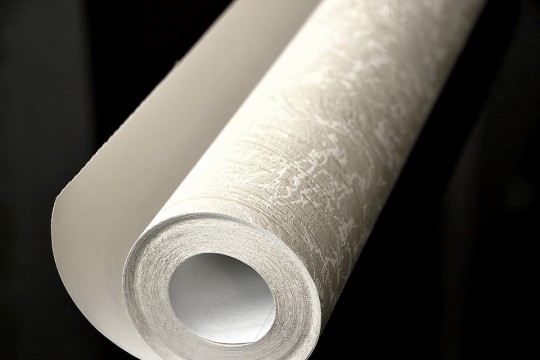
Anaglypta. A type of wallpaper made from the pulp of cotton fibre. It is a trade name but is now used to refer to any type of paper with embossed patterns that can be painted. The patterns are created by hollow mouldings. It is more flexible and lighter than its similar counterpart Lincrusta and was cheaper when it was first produced during the nineteenth century. It is very hard wearing and is most commonly used below the dado rail in halls and stairways.
Antiquating.Artificially ageing a painted surface.
Architrave. Door frame surround, normally ornamental.  Also known as trim(USA).
Arris. The external edge of two surfaces,especially  wood and panel-doors.
Art Deco.A design movement in the nineteen twenties and thirties characterised by rectilinear lines, geometrics, the stepped profile, lots of black gloss and mirrors, and stylised images of cars, skyscrapers and aeroplanes. It was chiefly influenced by the glamour of early Hollywood, Modernism, and Cubism.
Artex. A textured finish commonly applied to ceilings. Known as Ceiling Texture in the USA. It can be patterned in different ways by combing to create a variety of patterns. Artex is good at covering a whole range of imperfections.. To remove it, use a steam stripper first to soften the paint. Don't sand it off unless you're certain of what age it is; older paints often contain asbestos.
Art Nouveau.A European design movement that started in the late 1800s. It is characterised by the whiplash line, with designs featuring sinuous curves of flowers and other images drawn from nature.
Ash. A good quality hard wood, light in colour.
Asphalt varnish. Asphalt varnish is composed of asphalt pitch that is heat-treated with Gilsonite and thinned with mineral spirits or naphtha. Varying degrees of flexibility and toughness are obtained by varying the ratio of pitch to Gilsonite.
Astral. Akzo Nobel paint brand.